
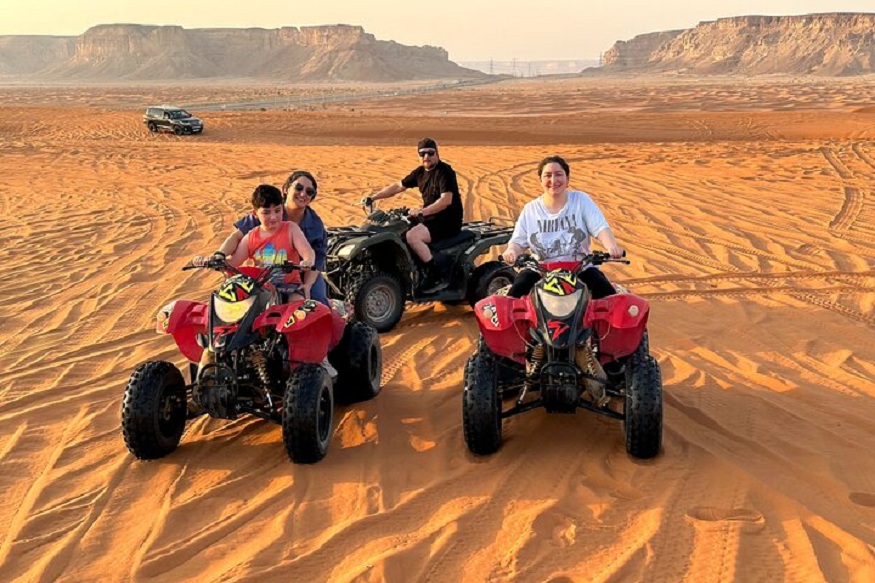
Most people describe dune bashing as “off-road driving on sand.”
That definition misses the point completely.
Because the real experience is not about driving at all — it’s about what happens when the desert starts dictating movement, and the vehicle becomes a reaction instead of a route.
The moment a 4×4 leaves the stable surface of the city and enters the dunes, something subtle changes. There are no lanes, no signs, no fixed direction. The landscape stops behaving like terrain and starts behaving like motion.
And from that point onward, everything becomes negotiation between physics and instinct.
The Desert Doesn’t Stay Still Long Enough to Predict It
One of the most misunderstood parts of dune bashing is the assumption that the desert is a static environment.
It isn’t.
Sand behaves more like a fluid than a solid. Wind reshapes dune edges constantly. One side of a dune might feel firm and climbable while the other collapses slightly under pressure. Even tire grip changes depending on heat and moisture levels in the sand.
That means no two passes across the same dune feel identical.
Professional drivers rely heavily on real-time judgment — not pre-planned routes — because the terrain itself changes as they move through it. This is where real desert safari Dubai expertise becomes visible: not in speed, but in reading instability before it becomes visible to passengers.
Why Dune Bashing Feels Like Controlled Instability Instead of Chaos
To an outsider, dune bashing looks like aggressive driving.
Inside the vehicle, it feels more precise than that.
Every climb, drift, and descent is a controlled response to shifting ground conditions. Drivers are constantly adjusting:
Read More: Creating Aircraft Interiors That Adapt to Multiple Mission Profiles
- Steering pressure based on sand softness
- Acceleration timing based on dune slope
- Momentum to prevent sinking in loose areas
- Turning angles to avoid rollover risk on steep edges
The experience feels chaotic because the desert is unpredictable — but the control behind it is deliberate.
That tension between unpredictability and precision is what creates the emotional intensity of a thrilling desert safari experience.
Why Gravity Feels Different in the Desert
Something strange happens during dune bashing that passengers rarely expect: gravity feels inconsistent.
When a vehicle climbs a steep dune, the horizon disappears. When it drops, the stomach reacts faster than the mind can process. When it drifts sideways, the body instinctively adjusts even though the vehicle is still under control.
This is not illusion — it is terrain geometry combined with momentum shifts.
Dunes are curved, uneven, and constantly changing elevation. That means the vehicle is never moving in a straight, predictable line. Instead, it is constantly transitioning between upward force, downward force, and lateral drift.
That constant shift in direction is what creates the physical sensation of instability — even when the driving remains safe.
The Role of Experience: Why Skilled Drivers Change Everything
Dune bashing is not defined by horsepower.
It is defined by judgment.
Experienced desert drivers develop a deep understanding of how vehicles respond to sand under pressure. They know when to accelerate through soft sections and when to ease off before a dune collapse. They can read subtle surface differences that most passengers never notice.
That expertise is what separates a smooth adrenaline experience from a rough, uncomfortable ride.
In professional luxury desert safari Dubai operations, this skill is treated as a core safety discipline, not just a driving style. It reduces risk while still maintaining intensity — a balance that is difficult to achieve without real desert experience.
Why the Desert Feels Different After Dune Bashing
Most activities end when they finish.
Dune bashing leaves a psychological after-effect.
Once passengers step out of the vehicle, the desert no longer feels passive. The dunes that looked still from a distance now feel like surfaces that can move, shift, and react.
This change in perception is important.
The desert stops being scenery and becomes an environment the body remembers physically — not just visually. That is why many travelers describe dune bashing as the moment their entire desert safari Dubai experience “clicked” into place.
Why No Two Dune Bashing Experiences Are Ever the Same
Unlike structured attractions, dune bashing cannot be replicated exactly.
Conditions change daily:
- Wind direction reshapes dune edges
- Sand firmness shifts with temperature
- Visibility changes with sunlight angle
- Group size affects driving rhythm
- Route selection varies by operator and safety conditions
Even the same driver on the same day cannot reproduce an identical ride twice.
Read More: HCB Yachts: American Craftsmanship, Global Luxury
That unpredictability is what keeps the experience fresh for returning visitors and why it continues to be one of Dubai’s most consistently talked-about desert activities.
The Real Nature of Dune Bashing: A Dialogue With the Terrain
The most accurate way to understand dune bashing is not as driving, but as interaction.
The driver responds to the desert.
The vehicle responds to gravity.
The passengers respond to motion.
It becomes a chain of reactions rather than a linear activity.
The desert sets the conditions.
The driver interprets them.
The vehicle executes them.
The passengers experience them.
That layered interaction is what gives dune bashing its identity — something between adventure sport, environmental reading, and controlled risk navigation.
Final Thoughts
Dune bashing is not defined by speed, danger, or spectacle alone.
It is defined by the relationship between human control and an environment that never behaves the same way twice.
In a well-managed desert safari Dubai, especially within structured luxury desert safari Dubai operations, it becomes a carefully balanced system of expertise, terrain understanding, and controlled adrenaline.
And that is what makes it unique.
Because in the desert, the vehicle is not really in charge.
The terrain is.
And the experience begins the moment you realize that difference.